
A rule is worth what it changes
"Stop after two losses." "No trades before the news." "Only London." These rules sound right, but each one also removes winning trades. The simulator answers the only question that matters: on your actual history, does the account end up better or worse?
- 1
Set a baseline
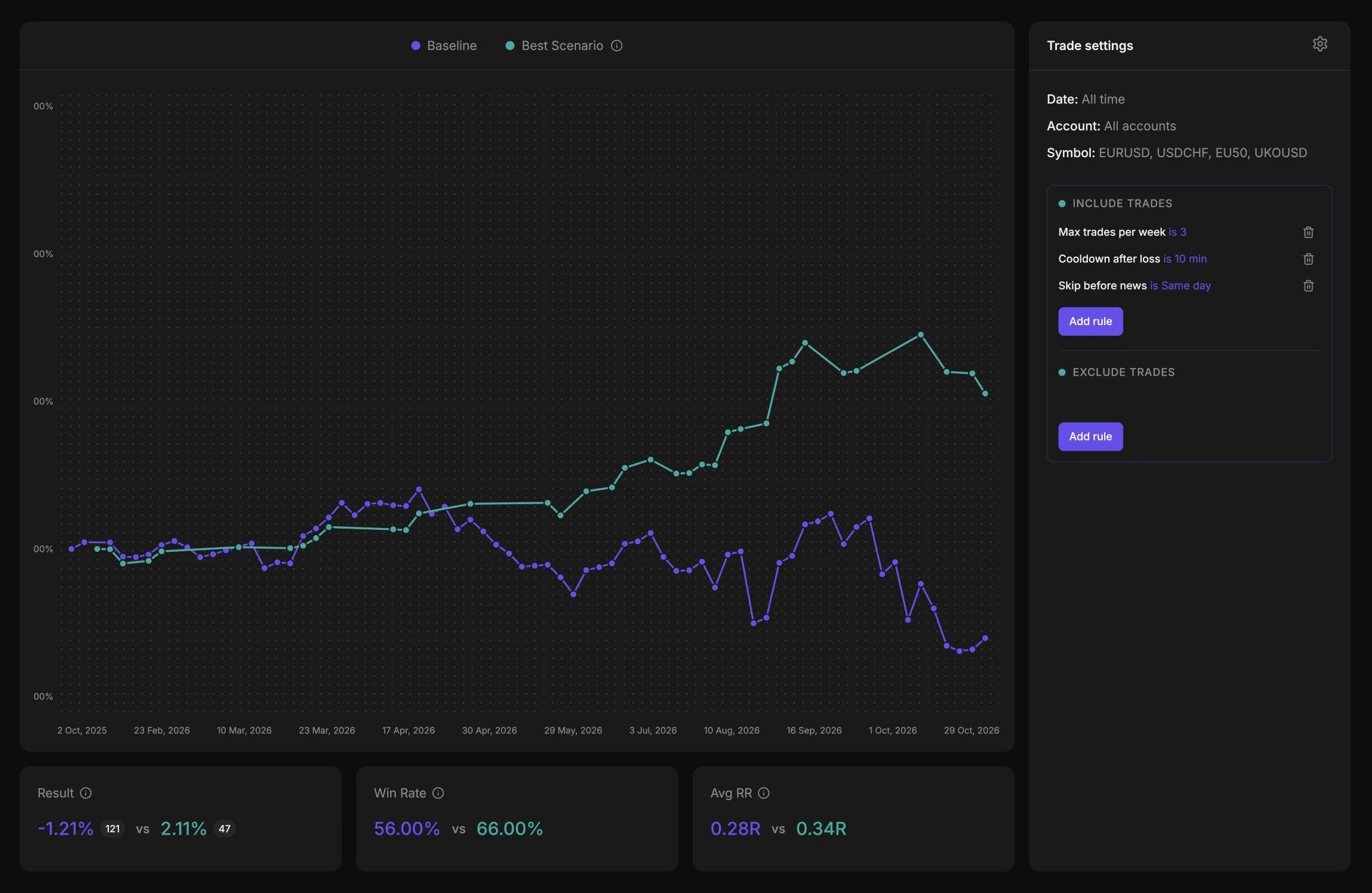
Start from your trades as they are, the curve labelled "as is".
- 2
Add rules
Switch on limits and filters. Trades that break a rule drop out of the simulation.
- 3
Compare the curves
The new equity curve is drawn over the old one with the difference in R, dollars and percent.
Rules you can test
Rules sit in two blocks. Include keeps only the trades that match, Exclude drops them. Press "Add rule" in either block and pick a parameter.
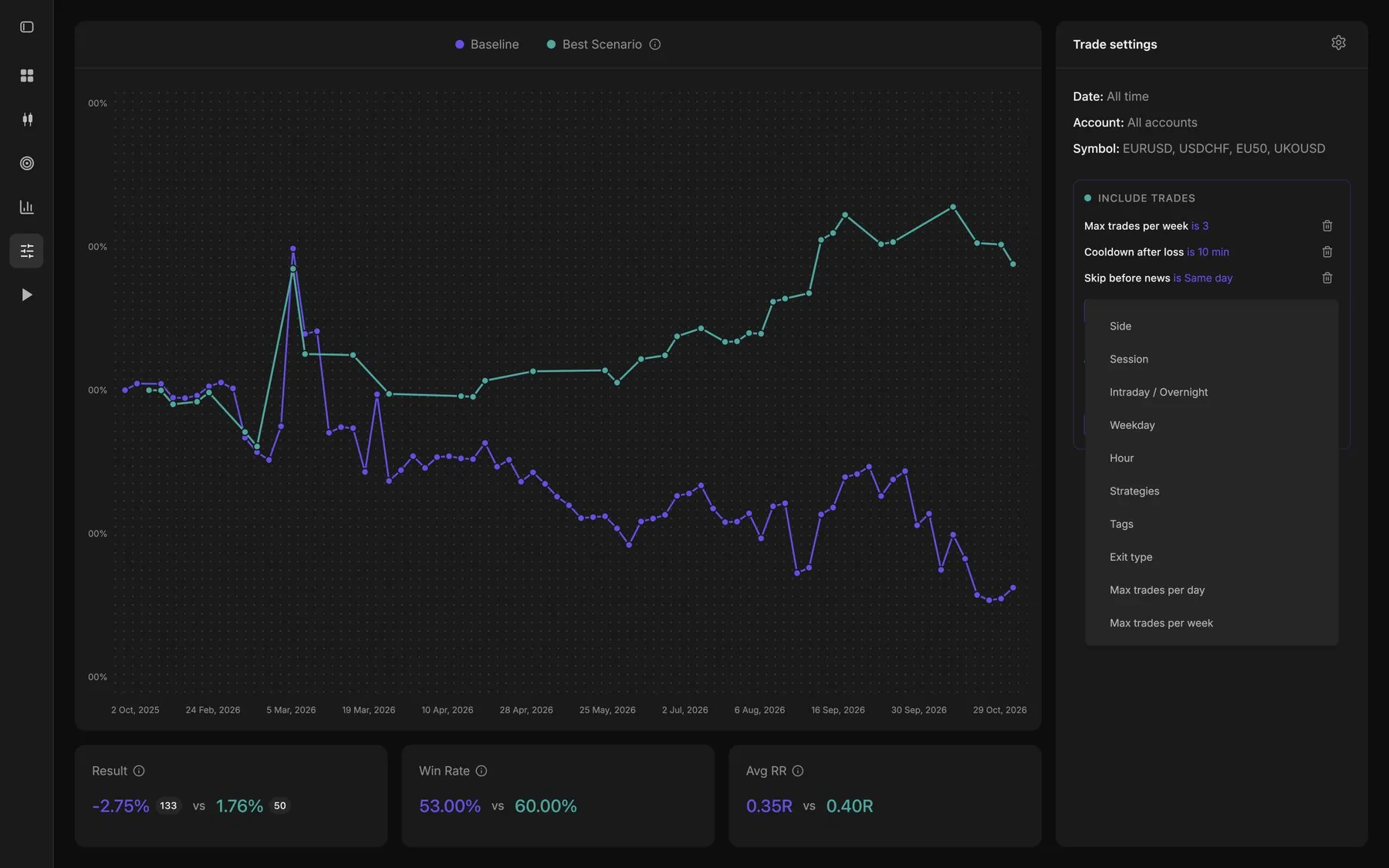
Filters: which trades stay
Direction
Longs or shorts only. Shows whether one side carries the account.
Session
Asian, London or New York, by entry time. Tests the "only London" rule.
Intraday or overnight
Trades closed the same day against trades held overnight. Shows whether holding overnight pays.
Weekend hold
Positions carried over the weekend. Measures the gap risk you take on.
Weekday
Any set of days. Shows what skipping your weakest day would change.
Hour
Entry hours from 0 to 23. Finds the hours to stay out of the market.
Strategies
Keep or drop setups. Shows the account trading one setup only.
Tags
Your own labels, such as "FOMO" or "A+ setup". Puts a price on a mistake you tag.
Exit type
Manual closes against closes by stop or target. A trade counts as automatic only when both levels were set. Shows whether closing by hand helps.
Symbols
Instruments to keep or drop. Tests trading fewer markets.
Result in R
A range of outcomes, for example losses bigger than 1R. Shows what oversized losses cost.
Limits: how much you trade
Trades per day, week or month
Only the first trades up to the limit count, later ones drop out. Tests overtrading.
Daily loss stop
No new entries once the day's loss reaches a level in R, counted by open date. Tests a hard daily stop.
Pause after a loss
Skips trades opened within a set number of minutes after a losing trade. The revenge-trading test.
Skip before news
Skips trades opened a set number of minutes before high-impact releases, or on the whole day. USD news counts for every pair.
Let the search find the rules
Testing rules one by one takes a while. Best Scenario searches combinations of filters on your history and returns the set that beat your baseline, with a short explanation of why. It needs at least six closed trades, and when nothing beats the baseline it says so instead of inventing an edge.
Two more questions it answers
Optimal take profit
Replays each trade on real candles to find the fixed target in R that would have returned the most.
Break-even level
Shows whether moving the stop to entry would have helped, and at which level, using broker minute data.
Treat every result as a hypothesis about the past. A rule that improves a small sample can be noise, so the simulator flags small samples. Test the rule going forward before you trust it with real money.